
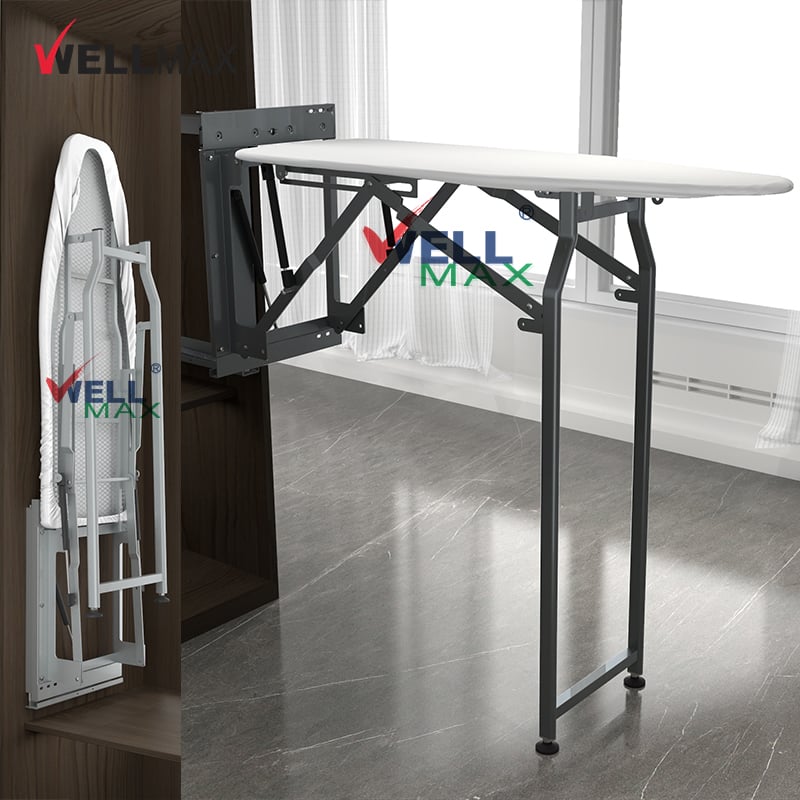
Choosing the Ideal Location for Your Wall Mounted Ironing Board
Aligning placement with laundry workflow and household habits
Position your wall mounted ironing board within 15 feet of primary laundry stations to align with natural workflow patterns. A 2023 Home Efficiency Study found households reduce ironing time by 25% when boards are placed along common paths between washing machines and storage areas.
Proximity to power outlets and storage for convenience
Install within 3–6 feet of electrical outlets to avoid extension cord hazards while maintaining easy access to steam irons. Keep essential supplies like starch sprays and pressing cloths in wall-mounted organizers within arm’s reach—a configuration shown to improve task completion rates by 40% in ergonomic assessments.
Avoiding high-moisture areas to protect durability
Steer clear of bathrooms or basement spaces where humidity exceeds 55%, as moisture accelerates metal fatigue in folding mechanisms. Industry testing reveals boards installed in moisture-controlled environments last 2.3x longer than those exposed to dampness.
Ensuring accessibility for all users
Maintain a mounting height between 34”–38” from the floor to accommodate both seated and standing users. The operable handle should require less than 5 pounds of force to deploy, meeting universal design standards for multi-generational households.
Measuring Clearance and Space Requirements for Smooth Operation
Determining Minimum Dimensions for Safe Deployment
When setting up these boards, leave at least 30 inches on the sides so people can move around comfortably without bumping into anything. For vertical space, most standard models need between 18 to 24 inches once folded away, but smaller versions sometimes get away with just 15 inches. Don't forget about how tall the person actually is either. Take this example: if someone who stands 5 foot 6 inches tall uses a board that slopes down at 15 degrees, they'll really need about 39 inches in front of them to stand properly without having to bend over uncomfortably all the time. Space matters a lot here for both safety and usability.
Measuring Swing Radius and Folded Footprint
Map the ironing board’s full deployment arc using painter’s tape:
- Mark the wall at maximum extension
- Swing board left/right to identify obstructions
- Verify folded depth doesn’t protrude past cabinets
Typical swing radii:
| Board Type | Folded Depth | Swing Radius |
|---|---|---|
| Standard | 6" | 28" |
| Slim | 4" | 22" |
Ensuring Overhead and Frontal Clearance
Maintain 24" clearance above deployed boards to prevent head bumps—especially critical in laundry rooms with low-hanging HVAC ducts. For frontal access, reserve 36" for unimpeded iron cord movement. Test clearance with actual irons: a 12" wide steam iron needs 40% more side space than manufacturer specs suggest.
Assessing Wall Structure and Mounting Surface Strength
Proper assessment of your wall’s construction ensures your wall mounted ironing board operates safely for years. Begin by locating wooden studs using a stud finder—these 16”–24" spaced supports bear up to 100 lbs when secured with lag bolts. Mark stud centers clearly with a pencil before drilling.
Interior drywall walls differ significantly from insulated exterior ones. The latter often contain vapor barriers and fiberglass batts that complicate anchoring, while interior partitions offer simpler access to studs.
Installing on exterior walls requires caution:
- Drill pilot holes slowly to avoid displacing insulation
- Seal gaps around brackets to prevent moisture infiltration
- Avoid mounting near plumbing vents or exterior faucets
If studs don’t align with your ironing board’s bracket, use heavy-duty drywall anchors rated for 50+ lbs. Pair them with #12 screws for shear strength, but never rely solely on anchors for full-weight support.
Lightweight models (under 15 lbs) marketed for hollow walls demand scrutiny— independent testing reveals 40% fail to hold rated capacity after 6 months of use. Prioritize models with dual-wall brackets or secondary stabilizers for safer daily operation.
Step-by-Step Installation of the Wall Mounted Ironing Board
Securing the mounting bracket to wall studs with lag bolts
First things first, find those wall studs with a good quality stud finder. Once located, mark where they are on the wall with some painter's tape so we can see them clearly later. Now comes the bracket placement part. Line it up against the wall surface making sure it sits nicely over at least two different studs. This helps spread out the weight properly across the wall structure instead of putting all the pressure on one spot. When attaching, go with 3 inch lag bolts rather than regular screws. Why? Because these bolts actually hold about four to six times better when something tries to pull away from the wall. The Hardware Safety Report folks did some testing back in 2024 and confirmed this extra strength makes a real difference in keeping things secure long term.
Aligning the mechanism for smooth folding and stability
When positioning the ironing board against its mounting bracket, it's important to check whether everything lines up vertically using a standard 4 foot level. If there's any noticeable gap between where the board pivots and the bracket itself, especially if it exceeds about 1/8 inch difference, then some adjustments will definitely be needed. Small alignment problems might not seem like much at first glance but they really do contribute to uneven stress distribution across those hinge mechanisms eventually leading to premature wear. As we tighten down those adjustment bolts, take things slow and test how smoothly the whole thing folds after each turn. Going too aggressive with torque here could easily damage components instead of securing them properly.
Testing deployment and retraction under load
After installation, conduct three critical tests:
- Deploy the board fully while applying 25 lbs of downward pressure (equivalent to a heavy steam iron)
- Rapidly retract the board 10 times to identify sticking points
- Leave the board half-deployed overnight to check for hinge creep
Case Study: Reducing wobble by pre-leveling brackets during installation
A 2023 ergonomic study found pre-leveling brackets reduced lateral wobble by 76% compared to post-installation adjustments. Installers who shimmed brackets to within 1/16" of level before final tightening reported 82% fewer service calls related to mechanical wear.
Installing optional covers or padding for user comfort
Heat-resistant silicone padding (rated for 500°F/260°C) can be added to the board’s edge using industrial-strength adhesive strips. This reduces forearm friction by 34% during prolonged ironing sessions while maintaining the original fold clearance. Attach covers before final bolt tightening to ensure seamless alignment with the board’s contours.
Final Safety Checks and Usage Optimization
Inspecting Locking Mechanisms and Hinge Stability
Test all locking systems under full weight capacity to verify secure engagement. A 2023 materials durability study found loose hinge bolts caused 27% of wall-mounted unit failures during deployment. Use a calibrated torque wrench to check fasteners every six months, replacing worn plastic components showing hairline cracks.
Ensuring No Interference With Doors, Shelves, or Fixtures
Maintain a 16-inch frontal clearance (aligned with National Safety Council guidelines) for safe operation. Check that fully extended boards clear light fixtures, door handles, and cabinets through multiple test rotations. For corner installations, ensure at least 12" of lateral space from adjacent walls.
Tips for Long-Term Maintenance and Performance
- Wipe surfaces monthly with pH-neutral cleaners to prevent corrosion
- Lubricate folding joints quarterly using silicone spray
- Retighten mounting bolts during seasonal temperature changes
Units receiving biannual maintenance show a 43% longer service life according to 2023 appliance longevity research. Store heavy irons separately to reduce mechanism strain between uses.
FAQs
What is the optimal distance from power outlets for installing a wall-mounted ironing board?
Ideally, the ironing board should be installed within 3–6 feet of electrical outlets to avoid the use of extension cords and to keep the area safe and convenient for ironing.
How can moisture affect the durability of a wall-mounted ironing board?
Moisture accelerates metal fatigue in folding mechanisms, leading to a shortened lifespan. It's important to avoid installing the board in high-moisture areas such as bathrooms or basements.
What space clearance is necessary around a wall-mounted ironing board?
You should leave at least 30 inches on the sides and ensure there is ample space for frontal access, typically about 36 inches.