
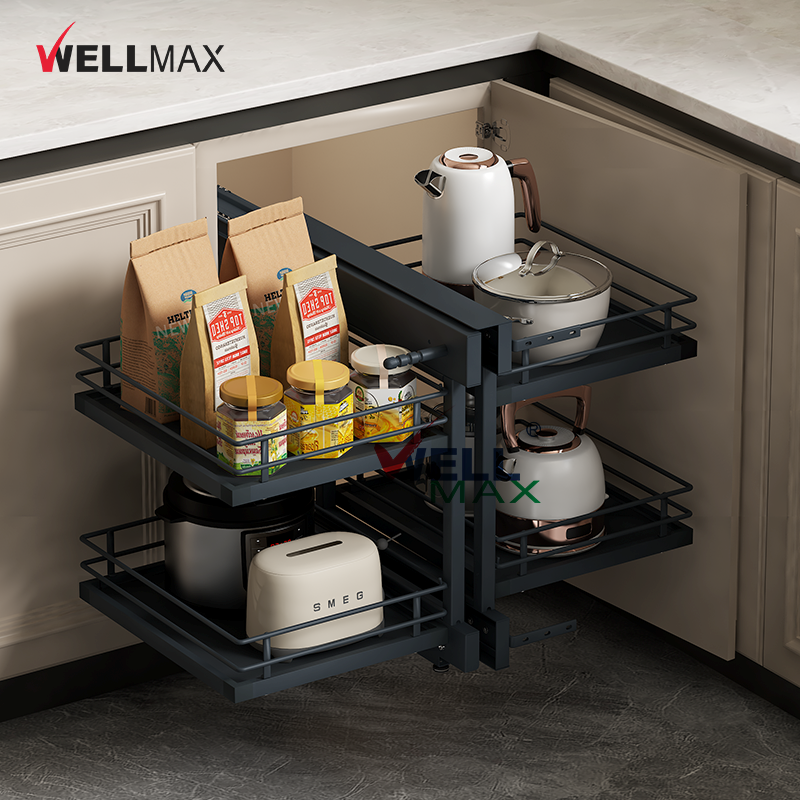
Why Blind Corner Cabinets Remain Underutilized
Most kitchens have blind corner cabinets sitting there full of unused storage space, but somehow nobody ever manages to make good use of them. The main problem is getting to what's inside those corners. Things get buried so deep that reaching for them means either crawling around on hands and knees or doing some pretty awkward stretching motions every time someone wants something. According to some studies done by the National Kitchen & Bath Association, we're actually wasting between 30% and 40% of our cabinet space because of this issue. These standard sized cabinets are usually somewhere between 36 inches and 42 inches wide, which makes organizing anything practical inside almost impossible. As a result, these corners tend to turn into junk drawers for old appliances nobody remembers buying or boxes packed away for holiday decorations that never come out again. People just stop trying after a while since they associate these spaces with frustration. Even when folks try using those spinning lazy Susan things, they still can't really fix the problem of reaching all the way back there. So many homeowners end up giving up on fixing their kitchen layout completely, thinking it's too complicated to change later, even though there are now plenty of new hardware options available that could solve these problems if only people knew about them.
How Magic Corner Systems Transform Blind Corner Functionality
Mechanical Advantages: Full-Extension Rotation and Dual-Zone Access
Magic corner systems tackle those pesky blind corners using some pretty clever mechanical engineering. When fully extended, these systems let hardware rotate items all the way around 180 degrees so containers stored at the back can actually reach the counter edge without anyone having to bend down or stretch awkwardly. The dual zone feature splits shelves into separate rotating sections, which means someone can grab spices from one tier while another person gets cookware from the other at the same time. The whole thing works on basic rotational principles really. There's a central pivot acting like a lever arm that spreads out the weight along the extension rails. Regular sliding mechanisms rely on friction, but these magic corners use roller bearings instead. That makes them run smoothly even when holding about 50 pounds worth of stuff, something kitchen owners appreciate when dealing with stacked dishes and heavy pots.
Magic Corner vs. Traditional Blind Corner Solutions: Lazy Susans, Swing-Outs, and Pull-Outs
Three dominant solutions historically addressed blind corners, each with constraints:
| System | Access Mechanism | Usable Volume | Max Load Capacity |
|---|---|---|---|
| Lazy Susan | Rotating turntable | 30–40% | 25 lb |
| Swing-Out Tray | Hinged forward motion | 45–55% | 40 lb |
| Pull-Out Drawer | Linear slide | 60–70% | 60 lb |
| Magic Corner | Dual-axis rotation | 85–92% | 100 lb* |
Most traditional storage solutions end up losing valuable space to their mechanical components. Take Lazy Susans for instance they typically waste about two thirds of that precious corner depth because of those central spindles taking up room. Swing out drawers leave empty spaces right behind their hinges, and even pull outs force people to reach awkwardly into those cabinet gaps. The magic corner system works differently though. It combines smooth rotational movement with fully extended slides, creating both a 165 degree turning radius and horizontal reach at the same time. When items are positioned straight toward the person using them, there's no more guessing where things might be hiding. According to tests done by the National Kitchen & Bath Association back in 2023, these smart designs actually give three times as much usable front space compared to regular fixed shelves. Makes sense when you think about it really.
Measurable Benefits of Installing a Magic Corner in Existing Kitchens
Integrating a magic corner system into existing kitchens delivers quantifiable improvements in storage efficiency and accessibility. Unlike traditional solutions like Lazy Susans that leave up to 40% of corner space unusable due to fixed shelving constraints, magic corner mechanisms maximize volumetric yield through intelligent kinematic design.
Case Study: 92% Usable Volume Gain in a Standard 36" Blind Corner
A 2024 Kitchen Storage Efficiency Report documented a retrofit project where a standard 36-inch blind corner cabinet was upgraded with a dual-zone magic corner system. Post-installation measurements revealed:
- Usable volume increased by 92% compared to pre-installation capacity
- Retrieval time for rear-stored items decreased by 78%
- Annual frequency of cabinet utilization surged by 210%
What makes this system work so well is how it extends in sync, getting rid of those annoying dead spots in cabinets by placing trays at right angles to where people normally reach. When tested out, homeowners found they had just as much extra space as if they'd added nearly two full base cabinets to their kitchen. And here's the kicker no need to spend around $3,200 on each new cabinet either according to NKBA data from last year. These kinds of tangible improvements show why magic corner solutions are becoming popular among folks looking to make better use of every inch in their kitchens without breaking the bank.
Future-Ready Blind Corner Innovations: Smart Features and Design Integration
Soft-Close Mechanisms, Load-Balanced Rails, and Sensor-Activated Lighting
The latest blind corner solutions come with some serious engineering upgrades that really boost how people interact with them day to day. Soft closing mechanisms stop those annoying cabinet slams, which cuts down on wear and tear while keeping things nice and quiet something that matters a lot in busy kitchen environments where cabinets get opened all the time. The load balanced rails spread out the weight across the entire system so they can handle way more stuff inside without making the drawers stick or jerk around. And there's this cool sensor lighting that turns on whenever someone opens the cabinet door, lighting up those dark corners where things tend to disappear. No more fumbling around for flashlight apps on phones anymore. All these different components actually complement each other pretty well in practice.
- Dampened motion preserves cabinet integrity
- Reinforced mechanics enable bulk-item storage
- Contextual lighting ensures safe item retrieval
This trifecta elevates blind corners from neglected spaces to premium functional zones. Future iterations may incorporate predictive maintenance alerts via embedded sensors, though current implementations already deliver measurable accessibility gains.
FAQ
Why are blind corner cabinets often underutilized in kitchens?
Blind corner cabinets are often underutilized because accessing items requires awkward reaching or crawling, leading to inefficient use of space and difficulty in organizing stored items.
What makes magic corner systems different from traditional solutions like Lazy Susans?
Magic corner systems use full-extension rotation and dual-zone access, allowing items stored at the back to reach the counter edge easily compared to Lazy Susans and other traditional solutions that waste space due to their mechanical components.
Are there any cost-effective benefits of installing magic corner systems?
Yes, integrating a magic corner system can provide significant storage efficiency and accessibility improvements without the need to invest in additional kitchen cabinets, saving homeowners substantial costs.